
Hebrews 11:1 — What Does Faith Look Like When You've Little Hope Left?
When Life Gives You Almost Nothing to Hold On To
"Now faith is confidence in what we hope for and assurance about what we do not see."
— Hebrews 11:1 (NIV)
Reflection
There are moments when hope becomes painfully difficult. The medical news is worsening, the person you love is slipping away, treatment has stopped working, or circumstances have narrowed until the future you desperately want seems increasingly unlikely. At that point, Christian language about faith can sound much easier from the outside than it feels from where you are standing.
Hebrews 11:1 joins faith and hope closely together. Faith gives substance to what is hoped for and assurance concerning what cannot yet be seen. That sounds powerful until grief places you in circumstances where what you can see is frightening. The test results are visible. The deterioration is visible. The empty chair, the unanswered telephone, the doctor's expression, and the changing expectations are visible. What you hope for may have very little visible evidence left supporting it.
This is where faith becomes more demanding than optimism. Optimism expects circumstances to improve. Faith rests its weight on God even when the outcome remains hidden and may be different from the one you are pleading for. A grieving Christian can therefore have very little confidence in a particular earthly outcome while still refusing to let go of God.
Start with the free sample
No email. No signup.
That distinction matters because people in grief are often told to "keep hoping" when they already understand exactly how serious the situation is. Faith does not require you to deny evidence, manufacture confidence, or persuade yourself that the outcome you want must happen. Hebrews directs attention beyond what is presently visible, towards the God whose character and promises remain larger than the evidence in front of you.
You may still be frightened. You may still expect bad news. You may even reach the point where you can scarcely imagine the future you have been praying for. Faith can remain when confidence in the outcome has almost disappeared.
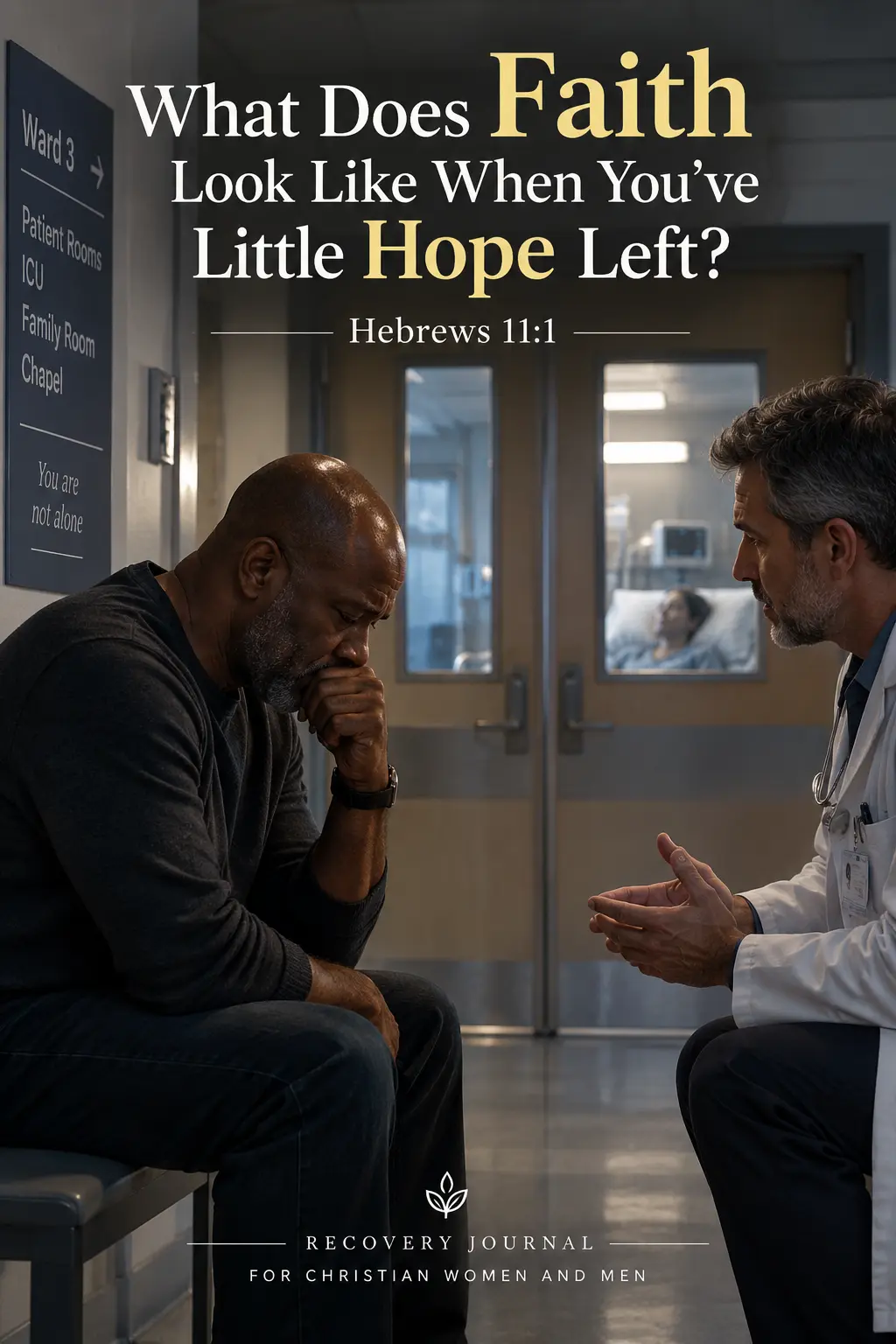
The scene reflects that pressure in the man absorbing serious news from a doctor while an ill woman lies behind the hospital doors. Everything visible points towards uncertainty and possible loss, while Hebrews 11:1 asks what he will trust beyond what he can presently see.
Biblical Insight
Hebrews 11 begins a long account of people who trusted God without possessing everything He had promised them. The chapter moves through Abel, Enoch, Noah, Abraham, Sarah, Moses, and others whose faith operated amid uncertainty, waiting, danger, displacement, suffering, and death. Verse 1 introduces that argument by linking faith with confidence in what is hoped for and assurance concerning what remains unseen.
The verse therefore offers something deeper than confidence that circumstances will turn out well. The rest of the chapter includes people who experienced extraordinary deliverance alongside others who were imprisoned, tortured, persecuted, and killed. Their shared faith cannot be reduced to believing that God would always produce the earthly result they wanted.
For someone facing grief or possible bereavement, that matters enormously. Faith in a hospital corridor cannot honestly mean certainty that the person behind the door will recover. Scripture gives no such guarantee. Faith concerns trust in God when the future is unavailable to you and when the visible evidence offers little reassurance.
Hope also becomes larger than one desired outcome. Christians may pray fervently for healing, recovery, more time, reconciliation, or rescue while recognising that none of those things can be demanded from God. Hebrews directs hope ultimately towards what God has promised beyond present sight. That may feel painfully remote when someone you love is critically ill, but it allows faith to survive without requiring false confidence about what happens next.
In Application
- Separate what you desperately want to happen from what you actually know. You can pray for the first while remaining honest about the second.
- Allow fear and faith to exist in the same moment. Being frightened by what you see does not erase the trust you are still placing in God.
- When your mind keeps predicting the worst, return to what Hebrews 11:1 actually gives you: confidence directed towards God and His promises rather than certainty about a particular outcome.
- Resist pressure to perform optimism for other people. Honest Christian hope can survive even when you admit that the situation looks very bad.
Practical Journaling
Reflect on Hebrews 11:1, then write honestly:
- What outcome are you hoping for most strongly right now, and what visible facts are making that hope difficult to sustain?
- What are you afraid will happen if the outcome you want does not come?
- Where does your faith rest when you cannot honestly say that you expect circumstances to improve?
- Which promise or truth about God remains meaningful to you even while the immediate future is uncertain?

Follow on Medium for More Studies
If writing feels too heavy today, read Hebrews 11:1 slowly and sit with the difference between what you can see and where you are placing your trust.
The Faith Recovery Journal explores this and many similar topics for Christians facing grief, loss, and recovery.