
Hosea 2:14 — How Does God Speak to You When Grief Leaves You Drained?
When the wilderness becomes the place where God speaks to you tenderly
"Therefore I am now going to allure her; I will lead her into the wilderness and speak tenderly to her." — Hosea 2:14 (NIV)
Reflection
Sometimes grief does not feel dramatic. It feels dry. You wake up tired, pray without much feeling, go through the motions, and wonder whether anything living is still left in you. Loss can strip the ground bare. It can leave your inner life cracked, hard, and empty. You are still here, but you do not feel fruitful. You do not feel strong. You feel like a dry place.
Hosea 2:14 speaks to that exact kind of suffering. God does not deny the wilderness. He names it. He does not pretend the barren place is pleasant. He says He will lead His people there and speak tenderly there. That matters when your faith feels worn down and your grief has made everything feel exposed. The tenderness of God is not reserved for your best days. It reaches you in the wasteland too.
Start with the free sample
No email. No signup.
That is often how grief works in a Christian life. Outwardly, you may feel dry, cut off, and unable to grow. But beneath the surface, God may still be sustaining what you cannot currently see. The roots are still there. The connection is not gone just because the season is hard. Hosea 2:14 does not say the wilderness is good in itself. It says God is willing to meet you there and speak there.
If you are in that kind of place now, this verse does not ask you to call the pain beautiful. It asks you to believe that desolation is not the same thing as abandonment. The Lord can still address you in the cracked places. He can still deal gently with you when your strength is low and your heart feels scorched.
Dry ground does not mean God has stopped speaking.
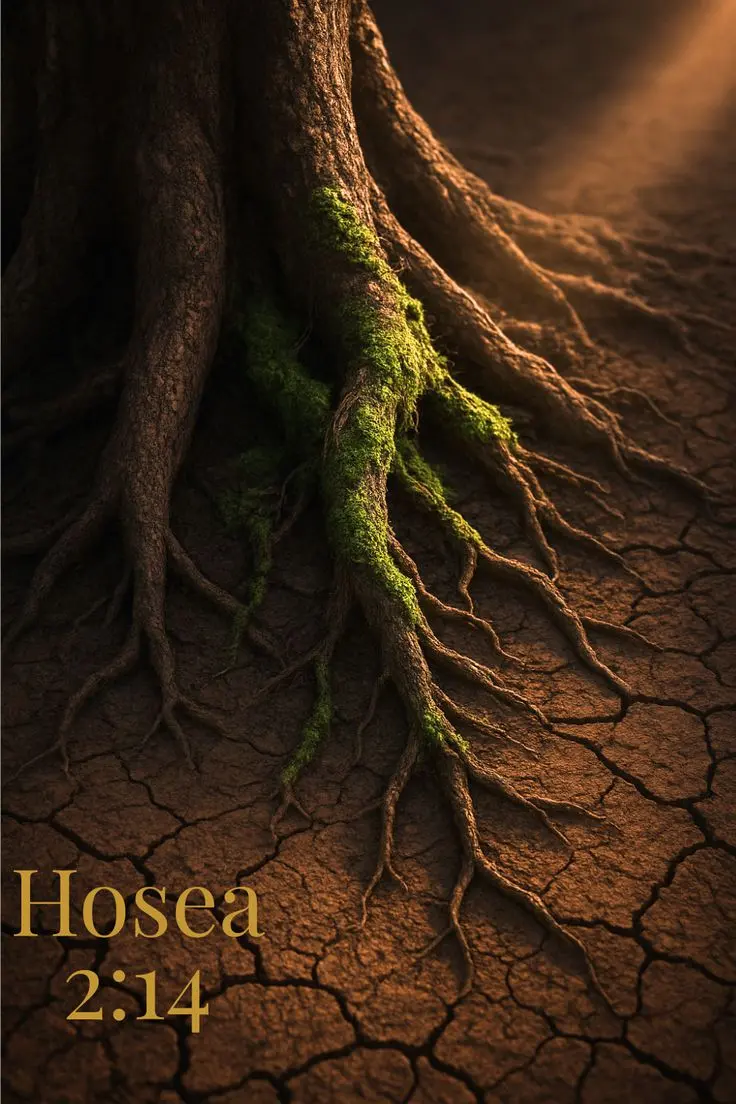
The exposed roots, the split earth, and the small streaks of green bring the verse into focus. The scene is not lush, soft, or easy. It is harsh and dry. Yet life remains attached at the deepest level. That is what makes it such a fitting picture for grief and spiritual exhaustion. When everything around you feels barren, God’s tender voice may be working where the eye cannot yet see growth.
Biblical Insight
Hosea 2:14 sits in a painful section of Scripture. God is speaking to Israel through the language of broken covenant, betrayal, and eventual restoration. The wilderness here is not romantic scenery. It is a place of stripping, exposure, and renewed encounter. God confronts His people’s unfaithfulness, yet He also declares His intention to speak tenderly to them again.
That means this verse is not cheap comfort. It does not say everything is fine. It does not say the wilderness is pleasant. And it does not promise that the barren place will instantly turn green. What it does say is that God’s response to His people is not only correction but also mercy. He does not only deal with sin or suffering at a distance. He comes near and speaks personally.
For a grieving Christian, this matters. There are times when loss makes you feel spiritually flat, emotionally numb, or quietly ashamed of how little strength you have left. You may assume God will only meet you once you recover your composure. Hosea 2:14 says otherwise. God addresses His people in the wilderness, not after they have escaped it.
This verse also does not mean every grief is a punishment. That would be too crude and too careless. But it does mean the wilderness is not outside God’s reach. He can use stripped-down places to get past noise, false supports, and distractions. He can speak with a tenderness that is easier to hear once everything else has fallen quiet.
So why does this matter? Because grief often makes people think in extremes: either I am flourishing, or God has left me. Hosea 2:14 breaks that false choice. You may be in a wilderness and still be led by God. You may feel barren and still be addressed tenderly by Him. You may be standing in cracked ground while hidden roots are still being kept alive by His care.
In Application
- Name the wilderness honestly. Do not call it “fine” if it is dry, lonely, or painful. Plain truth is often the beginning of hearing God clearly.
- Make room for quiet. Hosea 2:14 is about God speaking tenderly, and tender speech is often missed in a noisy, overfilled life.
- Look for root-level signs of grace. They may be small: one honest prayer, one Scripture held onto, one day endured without giving up.
- Stop assuming dryness means rejection. The cracked ground may be real, but it is not proof that God has withdrawn His care.
Practical Journaling
Reflect on Hosea 2:14, then write honestly:
- What does the wilderness look like in my life right now?
- Where do I feel dry, cracked, or emotionally worn down?
- What small signs of hidden life or rootedness can I still see, even if growth feels slow?
- What would it mean for me to believe that God can still speak tenderly to me in this exact place?

Follow on Medium for More Studies
If writing feels too heavy today, ask God simply to speak tenderly to you in your dry place.
The Faith Recovery Journal explores this and many similar topics for Christians facing grief, loss, and recovery.